ByJohn A
Benefits of Data Lineage Tracking
Data lineage tracking offers a clear view of data origins, transformations, and dependencies, reinforcing trust and compliance. It ties data quality to governance by clarifying ownership, enabling precise quality checks and policy enforcement. The approach supports faster collaboration and informed decisions through shared context, while strengthening risk management and accountability. Organizations gain scalable, lineage-aware analytics without sacrificing autonomy. The practical question remains: what step next will translate insight into reliable governance and tangible business value?
What Data Lineage Confirms for Trust and Compliance
Data lineage confirms how data flows from source to destination, illuminating the path that data products take and exposing every transformation, lineage, and dependency along the way.
It clarifies data provenance, enabling transparent traceability across systems.
Stakeholder trust rises as governance shows auditable histories, accountability, and compliant workflows, reinforcing confidence in decisions, collaborations, and shared risk management.
See also: Benefits of Data Fabric Solutions
How Lineage Boosts Data Quality and Governance
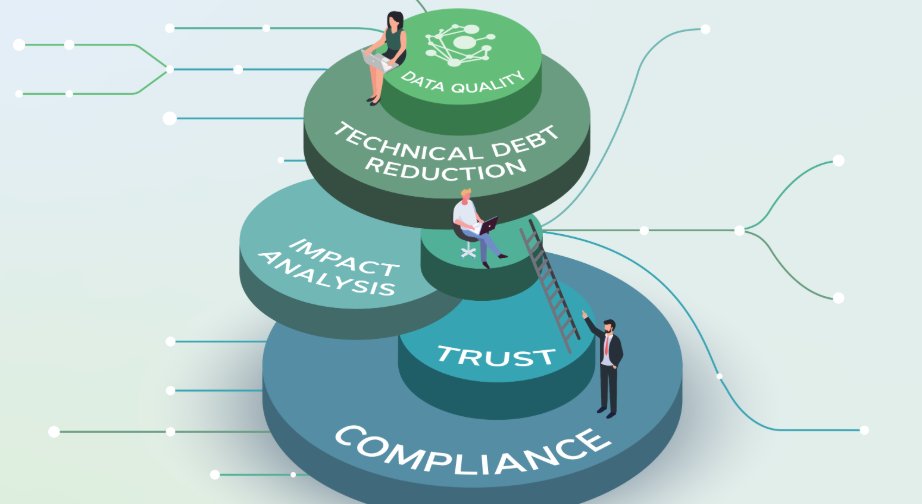
Lineage acts as a strategic framework that ties data quality and governance together, providing a clear map of how data is produced, transformed, and consumed across the organization.
The practice clarifies data lineage ownership, data governance responsibilities, and accountability, enabling precise quality checks, lineage-driven policy enforcement, and auditable provenance.
It aligns stakeholders, reduces ambiguity, and supports proactive quality improvement and compliant governance decisions.
What Lineage Does for Speed, Collaboration, and Risk Management
By mapping data’s origins, transformations, and destinations, organizations unlock faster workflows, clearer collaboration, and more proactive risk management. Data lineage enables speed optimization through transparent ripple effects, guiding decisions with precise provenance. It supports cross team collaboration by aligning context and expectations, reducing misinterpretation. Governance remains strong, while teams operate with autonomy and trust, pursuing strategic, measurable outcomes.
Choosing a Practical Approach to Implement Data Lineage
A practical approach to implementing data lineage starts with a clear, shareable blueprint that aligns stakeholders across data producers, engineers, and domain experts, while prioritizing achievable milestones over ambitious, abstract goals.
Teams evaluate governance, tooling, and integration paths, emphasizing data lineage reliability and maintainable processes.
Focused collaboration yields measurable improvements, and stakeholders recognize data traceability benefits as foundation for trust, accountability, and scalable analytics.
Frequently Asked Questions
How Is Lineage Data Secured and Access-Controlled Across Systems?
Lineage data is secured through strong authentication, fine-grained access control, and encrypted storage, ensuring accountability. Data provenance and governance controls enable auditable, collaborative enforcement across systems, balancing freedom with risk management and cross-domain trust.
What Costs Are Involved in Implementing Data Lineage Tooling?
Like a navigator charting unseen currents, the costs involved in implementing data lineage tooling hinge on cost considerations and tool licensing, plus deployment scope and governance needs, with collaboration shaping ROI and strategic, freedom-seeking outcomes.
How Frequently Should Lineage Maps Be Refreshed in Practice?
Refresh cadence varies by domain, but practitioners aim for frequent, value-driven intervals that balance effort and data freshness; typically quarterly to monthly, with adaptive bursts during releases, audits, or incidents to sustain data freshness and organizational alignment.
Can Lineage Support Impact Analysis for Regulatory Audits?
Yes, lineage supports impact analysis for regulatory audits by tracing data flows, formatting data lineage visualization for clarity, and embedding governance workflows; it enables precise risk assessment and collaborative evidence gathering while preserving freedom to explore.
Which Teams Should Own and Maintain Lineage Artifacts?
The ownership lies with data governance, defining clear ownership boundaries and responsibilities. Teams collaborate across data engineering, stewards, and compliance, ensuring ongoing maintenance, access controls, and documentation, while preserving autonomy and alignment with organizational goals and risk tolerance.
Conclusion
Data lineage answers the why and how behind data use, establishing a verifiable, auditable trail that strengthens trust and meets compliance demands. By mapping origins, transformations, and ownership, it anchors quality checks and policy enforcement in a shared, collaborative framework. This clarity accelerates decision-making, reduces risk, and supports scalable governance. In this interconnected landscape, lineage acts as the compass; its precise, collective visibility keeps the organization aligned and resilient. Like a tapestry, every thread reinforces the whole.